I am not a counselor or therapist or doctor and this is not medical or professional advice. See more detail on my disclaimers in Policies.
The loss of a spouse is a painful, disruptive trigger of big life change.
But which is worse? Losing a spouse due to death? Or losing a spouse due to divorce?
Let me preface this discussion by making it clear that this is not a competition. There are no winners in this sort of pain game.
This was written by a human. Not AI.
This is me sharing words from my brain, in my own quirky way, with you, just as if we were sitting together chewing the cud and spilling some tea.
Thanks for being here.
This is a deep dive into an interesting dynamic. From the outside the loss of a spouse in either form looks very much the same. The confusing overlap between the two can make it hard for outsiders to know how to offer support to the impacted spouse. Who can possibly know the right time to give a good ol’ girlfriend-ish push like “Hey, get out there and start dating!” And what if in some cases it turns out it’s the widow who is rarin’ to hop onto dating apps? And sometimes it might be the divorcee who prefers to fly solo for a while to re-establish some equilibrium before inviting a new variable into the equation.
While dating is an easy example, it is likely the least complex factor. Many other factors run much deeper. For example, there is deep trauma in both cases. In some cases that trauma is acute. And in some cases that trauma is complex trauma that has been inflicted physically and/or psychologically over many years or decades. The acute trauma from, say, the sudden and unexpected death of a spouse may inflict massive and immediate shock. Trauma that is experienced as a slow but steady burn can consist of thousands of repeated cuts into the same emotional wounds and scars over and over. After a while, shock morphs into an ongoing state of protective watchfulness and perseverance. Eventually this person’s brain and body can become completely re-wired by this culture of chaos to the degree that they are no longer the “self” they once knew, and may never be again.
But how can anyone see all this from the outside?
The list of varying impacts goes on. Financial impacts, career impacts, impacts on the kids, and more. And as the person attempts to move their lives forward, there are vast differences in one’s sense of personal control over their choices and the timing of those choices.
While the world looks on, the experiences of the widow and the divorcee could not be more different. Both events cut like a knife, but the cuts happen at very different times, and at vastly differing cadences and for different reasons.
Radical life transformation is hard.
The average person whose life is rolling along swimmingly rarely chooses to take on the disruptive task of completely redesigning their lives. Status quo and predictability feel good to most.
People who take on a big life change often do it because some life event triggers or even forces it. Events that trigger people to take on a major life transformation are often big ones, like getting laid off or inheriting a large sum of money unexpectedly, or becoming an empty-nester when the youngest child heads off to college.
The experience of losing a spouse in any way is one of those big life events that force the impacted person into the arduous process of imagining, accepting and implementing a fundamentally new way of living.
What starts as an unforeseen life interruption becomes an opportunity to ask:
“If I have 50-ish years left, that’s 17,520,000 waking minutes. How do I ensure that I will spend those minutes in a way that is the best expression of me? How can I be sure I will leave my bespoke mark here on Earth before I die?”
The life transformation project that emerges is like getting assigned to do a PhD thesis on a degree in which you had no initial interest. It feels inconvenient, uninvited, and unfit for the life you have worked so hard to build. Nevertheless, onward you go into a vast sea of change.
The way you move forward in this sea of change depends on the details of your loss.
If before the event the impacted (now single or widowed) spouse was working toward a certain vision for their desired future, how does this event impact her ability to continue on that path?
The history of the relationship may impact how each of these two categories of spouses might hold on to or handle past memories. For some, the memories might be warm and comforting. For some those memories and photos might be painful and triggering.
Socially, the type of loss each spouse experiences can elicit completely different treatment from the outside world.
Physiologically, the biochemical impacts of sudden vs slower, more progressive separation from a once-intimate partner can change the way one moves forward.
And clearly, the exact details of the situation can completely alter the emotional and psychological impacts. The logistical recovery from a calm, logical, peaceful divorce would look nothing like the chaotic battle that often occurs when a vindictive spouse would rather sink the whole ship than ever mediate fairly. And in kind, when a spouse passes away, the age of the couple as well as their children, and the degree to which there was time to prepare for that event impacts how much instability the death may or may not cause.
These variables are just the tip of the iceberg. As a divorcee myself, who also saw her father die at 50, I’ve had much time to think about the details. I communicate with and show support for friends who have lost their spouses in both ways, so I see how differently things play out.
Before I do a compare-and-contrast, I’ll start with the similarities
From the outside the world sees the same thing: a newly-single mom walking through the grocery store, attending appointments, showing up at parties solo, and being busy managing a household. Looks pretty apples-to-apples, right?
But guess what: even that similar scenario has differences when operating in society.
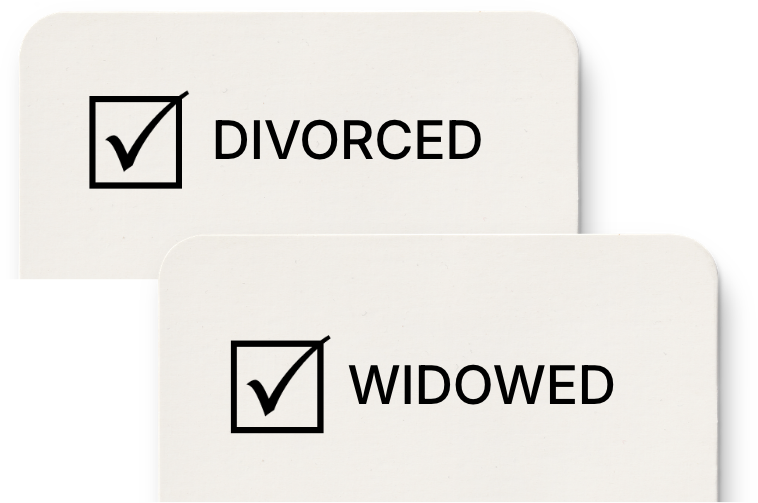
When the divorced woman fills out a medical form she is asked about her marital status and she checks the box that says __X__ DIVORCED
When the widowed woman fills out a medical form she is asked about her marital status and she checks the box that says __X__ WIDOWED
See? The world really seems to want to know which of the two camps caused your single-y situation. And from there the vast divide only widens. You yourself can probably think of many more than I have not noted. But for starters, here are a few off the top of my head.
Area of Life Impacted
Event: Death Scenario
Event: Divorce Scenario
Shock to current state of affairs at impact
The shock level is high. A highway of expectations has been zooming along on cruise control. It is then blocked abruptly. Every expectation comes to a screeching halt. All that can be seen now is a vast abyss of unknowns. This person may feel unprepared for this tidal wave of change. And her family’s working rhythm may become completely disrupted. If this person’s attachment to her spouse was strong, letting go may be an excruciating process.
As I have observed these points, but I have not gone through this scenario first hand, what other impacts or considerations do you feel could be added here?
This person has likely seen the writing on the wall for years. While there are some divorces that pop up out of the blue, I’m speaking to the large number of divorces wherein the likelihood of a split has been building over time. When one gets to the end of a torturous, expensive (see: costly couples therapy, programs, methodologies, and hundreds of guru books on relationships), time-wasting, life-wasting ride, they are likely done with a capital “D.” Unloading a source of pain, disrespect or abuse can be a relief. However, feeling responsible for disrupting one’s beloved children’s lives can be gut wrenching. The moment wherein a mother tells her sons there will now be two separate homes is dark. Never would anyone get married and have kids with the expectation that this conversation would eventually need to happen. Sadly, many women stay in unhealthy marriages too long purely in order to protect their children from this experience. As far as shock, this person likely has experienced many moments of traumatic shock. The revelation of lies, cheating, gambling, money-misuse, and more are horrible. But instead of being able to cry publicly at a funeral, this person must experience these traumas while still attending her children’s school events, and while still performing well at work and so on. But by the time the divorce gets underway, much of the mourning has happened. The pain of the loss of the marriage she’d hoped for is now baked into her everyday reality. And any therapy she’s been doing will likely have helped her place this reality into a somewhat positive and empowering framework.
First month after
When a spouse dies, there are rituals to guide the impacted spouse and all other people in what to do and how to act. Rituals make it clear that the next steps will include delivery of food, flowers and sympathy cards, the planning of funeral and burial ceremonies, and the assumption that the impacted spouse will be allowed to take time away from normal responsibilities, social commitments and any other pressures. People know to speak kindly and offer special care to this person for the next several months or more.
As I have observed these points, but I have not gone through this scenario first hand, what other impacts or considerations do you feel could be added here?
There are few rituals of support in the land of divorce. The experience is kind of like conducting a really, really long funeral but smiling and remaining a high performer throughout. The process is raw and rugged. A new turn of legal events occurs almost daily. The ability to plan for and implement a new form of normalcy is impossible until years later when the divorce is final. And while the impacted spouse may be able to share the daily drama with a few close friends, this sort of fodder often cannot be shared broadly nor would most people enjoy hearing it. While to the divorcing woman the daily events feel like newsworthy assaults, to the outside world it would eventually sound like a long, droning series of self-pitying laments.
The next three years
The long-term journey forward can look very different depending on the widow’s given scenario. The age of any children she might have, the nature of her work, and her financial status will all have different impacts on how she goes forth. A widow with children at home has to navigate care for her kids. Her financial situation will dictate how much flexibility she has to get support or to take time away from work to care for her children full time. If a spouse’s death triggers a life insurance payout, the impacted spouse is able to heal in comfort. She can often keep her house, and even take special beach vacations with her children to enjoy good times despite the loss. In contrast, in cases where there is little money to spare, the widow might not get much time to heal. Between work and efforts to care for the kids, she might struggle to find time for herself. And if there was a family business involved, there could be many high-pressure legal decisions to be made. Nevertheless, her new “normal” has begun. She will undoubtedly continue to mourn, but her solo life is, in fact, in motion.
As I have observed these points, but I have not gone through this scenario first hand, what other impacts or considerations do you feel could be added here?
Until the divorce is finished, it’s impossible to get your new life in motion. Major purchases cannot be made and your new home cannot be purchased. Your money, your choices, and your time are all tied to a legal battle that many narcissistic men like to carry on forever, like keeping a fish on the line for sport. And the legal games that are played are shocking hits that occur from out of nowhere almost every day. You have to check your bank accounts daily and you get scared when you scan your credit in a store, not always sure it won’t get turned off again.
Biochemical impacts
Death can be caused by a drunk driver, poor health, illness or a sudden episode such as a stroke or heart attack. When someone gets lots of hugs and cuddles everyday from their spouse, that affection and close contact drives up levels of the hormone oxytocin which Harvard Health notes as a driver of a sense of trust, attachment and stress reduction. A person who is used to a daily dose of this love hormone may go through a literal withdrawal from this drug. So in addition to the emotional losses in death, there can be physical impacts as well.
As I have observed these points, but I have not gone through this scenario first hand, what other impacts or considerations do you feel could be added here?
In divorce, if the disordered spouse has repeatedly committed acts that demonstrate their untrustworthiness, the non-disordered spouse has likely already begun the process of separating physically. The first, second or third time it’s revealed that your husband has a strange penis infection, or has been texting with buddies about hiring a “GFE” girl (I had to google that one when I discovered it), or has been unfaithful in any other way, most healthy women will see that their sexual health is at risk if they continue sleeping in the same bed as him. Et voila, the guest bedroom gets a new permanent resident. Therefore, by the time the divorce actually occurs, she’s likely already gone through detox from any oxytocin dependence she may once have had.
Public perspective on re-sharing over the long-term
Continual year-on-year re-sharing of mourning, sense of loss and more, such as in social media posts, is met with an outpouring of sympathy, extra love, and ample support.
As I have observed these points, but I have not gone through this scenario first hand, what other impacts or considerations do you feel could be added here?
Repeated expression of sadness over the unfair, undeserved loss of a would-be good marriage, and the loss of money and security as well, is just not seen as cool. And there’s really nothing to say in response. I have yet to see a Hallmark card that says “Thinking of you on this, the anniversary of your messy, 3.5 year divorce.” Divorcees simply need to do the work to build toward a better future and to place the past into a huge bucket of valuable lessons learned. But they cannot wallow; they must rather champion change.
Area of Life Impacted
Event: Death Scenario
Event: Divorce Scenario
Impact to kids
The loss of a parent is one of the greatest traumas a child could ever experience. In addition to the emotional impacts, there are social impacts when, for example, there is a father-and-child event, yet one child has no father who can attend. For the mother, her healing must happen in parallel to her efforts to care for her children’s healing journeys. The child does gain a sort of protection in the mere reality that the death is a publicly-known fact. People in the community are able to give the child special consideration and make extra efforts to be a supportive community to the child. And, again, the existence of known rituals can help immensely. From the funeral, to the allowance of extra time off, or time to step away to attend therapy, the child is able to mourn the loss of this parent. And in many cases, the child is able to mourn while living in their known family home, sleeping in their own, familiar bed.
As I have observed these points, but I have not gone through this scenario first hand, what other impacts or considerations do you feel could be added here?
As part of the divorce, assuming parents move to separate households, the daily life of the children is massively disrupted. Living in two households is not only emotionally hard on the child; it is a huge logistical handicap. The trauma of the divorce is compounded by the immense stress the child feels when having to constantly track what items have been taken home to which parent’s home. For a child who plays afterschool sports, and needs to have a freshly-washed uniform with him, along with the correct homework tools, computing devices and chargers, the tracking is a nightmare. There are just too many opportunities to end up in the “whoopsie - that one’s still in Dad’s car and he’s out of state this week.” A child may need to hop on the school bus only to realize the away game uniform was placed in the laundry bin at Dad’s downtown condo, and as Dad is away on a business trip, there is no one who can swoop by and grab it. While outside therapists can help with the emotional journey, the work to protect the child from the logistical stressors falls on the shoulders of the parents. And rarely do both parents offer equal effort. There’s often one parent who does more of the planning, protecting, and swooping and saving to ensure the child’s hard work in school and extracurriculars is not undercut by the chaos of living in two homes.
Financials
In cases wherein there are life insurance payouts, the mother and children are able to remain in their family home and to continue enjoying normal life activities. The ability to continue family traditions provides comfort and stability. Cozy nights watching movies and ordering food delivery or relaxing family vacations to the beach or to the mountains all help the children feel that their lives, their childhoods and their families have not completely disappeared. In other cases, total chaos ensues. If there is no life insurance, or if there was a family business that had no succession plan, or if the spouse who passed away was the sole source of income, the household can be completely uprooted. Stability may be found by selling the family home and moving back with one’s parents, or by taking on a new job. Either way the stress and complex layers of change will be felt by all. Healing takes a back-seat to mere survival.
As I have observed these points, but I have not gone through this scenario first hand, what other impacts or considerations do you feel could be added here?
Divorce costs, and the destructive events that too-often come with the divorce process, can create extreme instability for each household. Pressures to move into a rented home rapidly, and yet not be able to use joint funds to purchase a permanent home, are very disruptive. Furniture, objects, and basic set-up of living spaces are all swirled into a vortex of movement and change. Everything goes into storage, but then where does the child do homework in the new rented home? And where did all the child’s favorite games get boxed up and stored? It’s a few years of having to live in a fundamentally different and uprooted way. During that time, finances are very unstable. One would hope that courts can properly protect each spouse from financial abuse. However, the reality is generally very different. Repeated sudden sweeping acts are de rigueur. Credit cards get shut down with no warning, including while the mother is traveling on airlines with the kids. One cannot even check a luggage bag, or buy a single morsel of food, when all credit cards suddenly get shut down. In addition, other bizarre games unfold, like the court enabling one spouse to control “payments” to the other parent, and then using that power to create constant fear and chaos by randomly not making payments and withholding those payments until the other spouse pays $15,000 just to take them to court mid-divorce to get the judge to simply say “sir, make the payments on the first of every month, please.” But there is no punishment or justice for that. It’s just $15,000 wasted, months of stress, and the money-controlling spouse simply nods and says “oh, yeah, I just got a little disorganized.” This is not always the case. I have heard tell of the men who are considerate and mature and enable the family to remain in the home and who participate in a fair and equitable splitting of assets. Neither I nor most of my friends were that lucky. Too often a man scorned will use every available lever of control to inflict pain and discomfort and chaos. I have not heard just one, or two, or three stories that are like mine. I have heard, flat out, just far too many. In fact, it was a man who warned me when he saw me trying to play by the rules, in hopes of getting a simple fair split: “You don’t get it. He does not want to see you get a fair split. He wants to see you hurt. He sees this as a war. And you are his target. His ego’s been hit and he’d rather crush you than sit with the emotional pain his ego’s experiencing. So from now on, wake up every day ready for war.” And again, that was a man, speaking of how he himself felt in his divorce. I thanked him for his honesty as it helped me put on my strategic big girl pants from there on out. As the divorce finally wraps up, the financial rebuilding becomes a new full-time job. All new accounts, all new paperwork, all new trusts and wills, and much more. After years of swimming in divorce documents, one dives into a new sea of paperwork and clean-up. Money-wise, there is of course no life insurance payout as no one has died. Funds have just been wasted, spent, and split. The attorneys and forensic accountants are the only winners.
Ability to begin healing
Death is a shock and a tragedy. One can begin to heal from day one, however that process is a long, hard journey. Letting go of something that felt so good, and was such an important source of comfort can be a life-long process. There are as many ways to go through this process as there are books in the self-help section of any library or bookstore.
As I have observed these points, but I have not gone through this scenario first hand, what other impacts or considerations do you feel could be added here?
The divorce battle often impedes one’s ability to really heal. The daily onslaught keeps individuals in a perseverant, watchful mode. There is little time to really settle into a new way of life and begin to feel both the losses and the gains of divorce. However, while letting go of the dream of the good, caring relationship one deserved is made a bit easier by the immediate relief of letting go of the reality which was a person who was inflicting pain in your life daily. You know when you have a really sore muscle, and then a massage therapist finally digs into it and you feel a release? That’s divorce from a nasty relationship. Still a little sore, but ahhhhhhhh. So. much. better.
Area of Life Impacted
Event: Death Scenario
Event: Divorce Scenario
Feelings about the last 5-20 years
A five, ten, or twenty-year marriage is sad to cut short. But if they were good years, they can be a warming comfort to look back on.
As I have observed these points, but I have not gone through this scenario first hand, what other impacts or considerations do you feel could be added here?
Five, ten or twenty years spent trying to fix something that refused to improve is kind of a bummer. That bummer becomes a deep complex PTSD if after years of best efforts, horrible lies, falsehoods, cheating episodes, money-movery, and more are slowly uncovered. What a girl thought was her last two decades can turn out to be a dark and punishing nightmare. There’s no “snap out of it” or “well, it’s not so bad” button. Deep and horrid injustices just don’t sit well. Strong, smart, hard-working, dedicated women are not keen to wear the victim flag. But the jaw does drop for a while. It takes a while to transition from feeling bloody gobsmacked to fiercely empowered at which stage you can finally, and bravely redesign all the scratched-out memories into mere chapters in a long and lovely hero’s tale.
Memories and family photos
Family photos are cherished, valued for the rest of life. While they might hurt to see in the short-run, they are deeply valued assets to pull out in the long run. They are sources of heartwarming stories, sentimental wedding toasts, and tear-jerking notes in a Hallmark card. “Your Dad loved you so much…” “Your Dad would have been…” "Remember how Dad would always…” Yummmmmm. Hurts so good. Missing but remembering fondly is a gift, in my humble opinion. Any chance I get to share a memory of my father with my sons, it is a joy.
As I have observed these points, but I have not gone through this scenario first hand, what other impacts or considerations do you feel could be added here?
Family photos are good for the kids to have access to now as well as later in their lives. But for an impacted spouse, the photos might be re-triggering sources of trauma. The Christmas photos in 2003 and you think “Oh my God, that’s literally a week before he came home with that weird penis infection and told me he was taking an extreme medication simply out of precaution.” And the photos at his college group’s tailgate, where everyone was laughing except for you, and it was revealed only 8 years later that they were laughing because in the photo was a woman who the husband had cheated on the wife with in their last New Orleans trip. There are too many land mines in old photos. Advice: No matter WHAT the state of your marriage, for women, stop playing photo sherpa, always taking the photos and putting your husband in the photo with the kids. Take all photos of you with your kids first. Also: God Bless AI photo deletion of the ex. There are few justices in divorce but righting those wrongs is heaven. It takes years to undo the damage of long-term lies, gambling episodes, overall trickery, weird mind games, and literally financial thefts. Getting re-surprised in photos is an unnecessary repeated injury.
Making decisions about the future
If the family is able to remain in the family home, the impacted spouse has time to make life changes slowly. This affords her self agency, vs the reactive chaos state that tends to take over the lives of both widows handling a forced move or career change, as well as divorcees living for 2-4 years in a disabling series of legal incursions. The greatest gift is to get to your own new tabula rasa. Whatever emotional healing is needed, having the ability to set your own pace, is the unlock to some sort of do-able future.
As I have observed these points, but I have not gone through this scenario first hand, what other impacts or considerations do you feel could be added here?
Two to four years of rapid fire responses to the never-great-for-anyone events in a divorce completely block the ability to own one’s choices or decisions about the future. Every dollar, account, and decision is enmeshed, entwined and entangled in the unknowns of the games within and unknown outcomes of the divorce process. When a divorce goes to trial, timelines expand and the stakes spike sky high. It can evolve into years of aggressive games mixed with a decision-devoid cold war. Keeping the chess board open is all one can do. And it sucks b@lls for the kids and the mom in terms of having the ability to transition to a healthy new normal.
What other factors can you think of?
There are almost too many.
Notes from a Small Island: One Divorcee’s Post Scripts
I’m borrowing Bill Bryson’s small island reference because the day my divorce papers were finally signed, I followed through on my commitment to do all things “IRL” ( “in real life” ) by buying an island salon. But why?
My entire career in global cross-industry corporate change management communications had been encased in barely-human packaging, not unlike that of the boy who lived in a bubble. The impacts to single individuals were invisible when huge corporate reorganizations, layoffs, rebrandings, mergers, acquisitions, or outsourcing projects were underway. Eighteen-month rollouts of strategically-planned corporate reorg initiatives were executed based on multi-layered Excel spreadsheets. The details captured therein included actions and the accountable tech or legal or regional or HR-compliance teams. In any knowledge worker-fueled organization, human capital strategy is at the root of every project, but human capital strategy’s impacts on humans, and the children and families of those humans, was not part of the math. In fact, any hint of public perception that might blame the company’s actions for negative impacts to employees and their families would be immediately washed away with a massive positivity campaign designed to counter any negative claim or argument.
So in those days I did my best work in order to support that machine. My life from 3:00 a.m. to 1:00 a.m. each day, Sundays, holidays, and my kids’ birthdays included, were jam-packed with long global conference calls and urgent revisions to documents that defined every next action required by teams around the world.
My high-stress world lived inside a computer and on long, exhausting plane flights. I had seen many peers finish their careers with a quiet “bleep” as their LinkedIn profiles faded away from the algorithm’s favor. The pride of being “too busy” and so in-demand extinguished in a mere moment.
Good work had been fed to the machine for decades, but that one individual top contributing employee was leaving behind no legacy. This, to me, is the world's greatest nightmare. In the story of How to Train Your Dragon, the climax of the film focuses on the revelation that all of the fierce and individual-seeming dragons are, in fact, mere servants to a greater beast. They are duty-bound to feed the beast day-in and day-out. This is the career of a consultant in what those in the know call Big Time Consulting. Planes, trains, automobiles, and in-speak-y acronyms, stories of the most expensive wines at a client dinner, tales of shaking hands with bigger and bigger billionaires, and… what? What else? That’s really it. Just a lot of really, really good hard work performed, but not for a higher purpose. Just to keep a machine running to make the most wealthy B2B execs more wealthy.
I’d been researching, developing and refining my KindEdge life change planning system for many years prior to my divorce. I’d done the deep work to face the truth of what my epitaph would say if I remained locked-in to my toxic spouse and my purpose-devoid career.
So when my divorce papers were finally signed, I set off just like Dorothy in the Wizard of Oz down a wacky, wild path of total unknowns. But I was committed to touching and feeling and experiencing all these future experiments In Real Life.
I purchased a beauty and health salon on an island. It was profitable and had a long history. And yet it was not yet technology-enabled nor was it selling other brands and products. It was something I could easily dig into and grow into an automated self-sustaining business that I could run while also doing my higher-purpose writing on the side. Except…
That all happened just before the 2020 pandemic hit. So in parallel to my efforts to implement new software solutions, I spent my savings to keep every service person in that salon whole throughout the pandemic. And when I was not doing that, I was meeting with pandemic-related inspectors, fire marshals and other strange players in that game. I certainly got the “IRL” experience I’d asked for: a year of interesting, bizarre, exciting, sensual, romantic, burdensome, complex, and costly experiences. You can imagine the full spectrum of “all the things”. They all happened.
From there my IRL quest only deepened. I left the divorce war and entered into a pandemic small business war which was then followed by a double-hurricane-flood ward when my home got flooded in the 2024 back-to-back hurricane-floods in St Petersburg, Florida. The battles since then have been merely an unjust, circular homeowners association insurance fraud war.
Most people would have seen these events as overwhelming shock and trauma. But because I had done so much deep work to develop the KindEdge system to align one’s life toward their higher purpose and their legacy, I knew how to appreciate and use every event as a pencil sharpener.
One of my KindEdge inspirational products reminds us that Trouble is Your Trainer. This training makes you stronger and better able to help everyone else in your life without flailing about in useless reactivity. When you embrace the gift of change, miraculously good things come of it. So along with the traumatic events of my divorce, the pandemic, and the flood, I went deep on my KindEdge.com practice of conscious curation:
I took every day as an opportunity to start with a clean slate wherein I could re-choose every objects, person, environments, habit, and daily routine I allowed into my life. I quickly grew into a fundamentally different person living a fundamentally better-fit-for-me life. Ahhhhhhhhhhh.
But how might this stage look for a widow?
I have no clue. Can’t even guess. You tell me. I’m only smart enough to know what I don’t know. But that’s where the sidewalk ends.
Here are a few of my observations from the way outside, medium outside, as well as from the way inside area of the outside:
For some, social media posts of missing, remembering, hurting, mourning that ensure daily and weekly for many many years
For some, silence
For some celebration that their children are able to go on with their planned, lives, normal vacations, and more
For some, annual moments of gratitude
For some, immediate sexual interactions, including with married men I cannot guess how they feel years later)
For some, pretty balanced approaches including a year or two of pause, year or two of dating, and then a marriage that carries on the life pretty darned well.
For some, an appreciation of the marriage but an equally-great appreciation of the freedom to pursue any sort of relationship they desire going forth.
And still, I have no guesses on all the bits and pieces on the inside. Am I glad that I was in “divorce” vs “widow” mode? No. I just knew that my bespoke set of life skills, based on my bespoke life journey, fit my given series of events.
What Disabling Aftershocks Might Lurk?
For me, while many tears were shed during the marriage, no tears were shed for the loss of the ex in the divorce. In fact, losing 220 pounds of dead weight was kind of magical. Heroically regaining control over my life, despite ongoing physical hardships and surgeries, was a glorious chapter in my hero’s tale.
But every once in a while outside sources serve up messages that suggest that everyone deserves a partner they can trust. Or social media suggests that everyone should have a photo album full of safe, heart-warming memories. There are no Hallmark Cards that are like
Whoa! That was an f’d up [childhood, marriage, job, situation] you went through. You are a friggin’ rock star. Love yourself and rock on!
Antidote to the would-a-coulda-shoulda
The rear view mirror is not potential energy. Your remaining life minutes are a gift that you can now choose to give to anyone: a children’s charity, a new business, works of art, or new relationships of any kind. And for those who have endured a toxic divorce, you have gained x-ray vision into all souls; your well-trained gut can tell who is a black hole and who has a heart of gold and might be worth your time.
The past will never be fixed or perfected. The only thing that can be perfect is right here, right now, in your mind and in your heart. Every once of power in the universe lives in what you do next. Choose wisely.
As a matter of practice, as I write this, I imagine that midday tomorrow I will get hit not only by another memory of past hurts, but also by a car. The way I invest my time today are based on what I can pay forward, not on what lies in the past.
Mindsets Moving Forward
Rising Divorce Rates are a Good Thing
The entire world needs to re-think how we analyze divorce rates. Divorce is a good thing that has, for much of history, been a desperately-needed yet much-denied option for the millions of spouses who were trapped in an unfair or abusive marriage. Step crying foul over rising divorce rate. Let freedom ring. The more health and safety that becomes available to otherwise-trapped spouses the better for society. Higher divorce rates within an evolving framework of truth and choice are a sign of success.
Only people who don’t understand data would look at the numbers and think “isn’t the increase in divorce a shame?” The real data illustrates that women have for too-long endured horrible, abusive, disordered or simply controlling and dismissive marriage, but with every ounce of choice and freedom, they choose self-agency and they have no lack of willingness to achieve success on their own.
Retrospective Points of View
I do kind of have a sense that I lost my spouse. But I lost a spouse who also lied about many big and little things, and who smacked me around with financial abuse and legal games, and who inflicted psychological games that were only revealed after decades of decoding. So I kind of had the loss somewhere in the middle, and then simply unloaded the junk at the end.
In contrast, the safe, tight, trusting ties in a living, breathing family are the most raw cut one can imagine. When I lost my dad at 21, ooh, it was rough.
But the more useful, global perspective might be that we can assume every person on this Earth is navigating some sort of event, or trauma, trigger or loss.
Mitákuye Oyás'iŋ - We are all related.
I've lived this for many years and have very kindly bowed to all. I have poured my love and sympathy to each person I know who is affected by the death of a spouse or other family member. I give just as much love to divorcees. For all parties, it takes a huge commitment to manage one’s health in order to be able to carry on with gratitude for what is in this life. That is the only thing that anyone can do. Moving forward is work. And it’s also a huge opportunity. It is the best time to take on that big, complex project of redesigning your life to make sure every remaining life minute is invested only in the things that matter most to you.
I built the KindEdge process for me. And I share it here because that enables me to go to bed knowing, if I die tomorrow, I have handed over my learnings to you.
Una conversazione divertente e schietta con Graham, ingegnere di gara in Formula E, su come entrare nel settore del motorsport, come ha scelto il suo percorso di studi, quali ingegnosi strumenti di ricerca online ha usato e come ha applicato in modo naturale gli strumenti di KindEdge basati sull’ikigai per raggiungere una carriera da sogno “impossibile e poco pratica”.