


Hope is like crypto — it can feel like everything is possible, but there is no guarantee of a return on your investment. Action is like rocket fuel — it moves you, it creates heat, and it generates real information about what is actually between you and where you want to go. The rest is still unwritten is a beautiful idea. But someone has to get up and start writing that unwritten rest. In your life, that someone is you.
What Is the Danger of Staying in Hope Mode Too Long?
Every morning you open the refrigerator and see the quote on the door: the rest is still unwritten. Those words are meant to instill hope. They work like a warm, cozy sweater that makes you want to curl up on the couch and dream.
And there is real value in that at the right moment. When you are dealing with hard life events or fighting off anxiety about the future, being reminded that all is not lost is genuinely useful. We all need a soft landing from time to time.
But there is a clear and present danger in letting those comforting words keep you in a positivity-induced state of inertia. Hope is like crypto: it sits there looking perfect and filled with the promise of a positive future, with no guarantee of a return. The danger is that hope lulls you into a passive mode where you spend your remaining life minutes imagining that some magical change will happen to you. It will not. Change happens through action. Always.
How Do You Know If the Itch in the Back of Your Head Is Worth Acting On?
Here are some honest questions worth sitting with:
- Do you dutifully follow through on your career, but every time you read about someone who just published a play, finished an Ironman, or started a business, you feel a sickening twinge of something? Does it trigger that thing deep inside you that is dreaming of a different ending to your life?
- Do you feel like you peaked early and are now stuck in a plateau?
- Do you want to start something new but the idea of starting from the bottom again sounds like a dark, mysterious abyss?
- Do you crave a completely different lifestyle but dread negotiating that change with all the people in your life who expect you to stay the old you?
If any of those land, the itch is real and it is worth acting on. There is no downside to trying. If a change has the potential to make every remaining minute worth more, it is worth the attempt.
Why Is Today a Better Day to Start Than Any Day in the Future?
No day in the future will be easier than today. That is not a motivational phrase. That is a practical observation based on how lives actually work. Every future day has the same number of competing demands as today, the same number of people with claims on your time, the same human tendency to let the important thing lose to the urgent thing.
What is different about today is that you have the minutes right now. The future is not guaranteed. The window you are looking at right now, with this exact set of available resources and energy, will not exist again. January 1st is not easier. Next quarter is not easier. After the kids grow up is not easier. Today is what you have.
This is why the KindEdge program starts with one thing only: can you protect 15 minutes a day for 28 days for the Project of You? Not a full hour. Not a perfectly scheduled week. Fifteen minutes, tracked in a binder, to give the thing that matters the signal that it is real.
What Does the 28-Day Notebook Actually Reveal That a Plan Cannot?
The 28-day notebook is not a planning tool. It is a diagnostic tool. That distinction matters enormously.
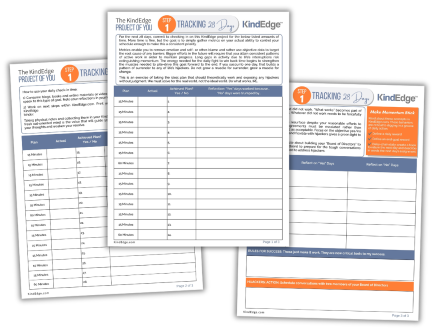
A plan tells you what should happen. The notebook tells you what is actually happening in your life. And those two things are often very different.
When you track 28 days of protecting fifteen minutes for your goal, you are not just accumulating progress. You are generating data on your real ecosystem. The babysitter who did not show up three times in a row. The employer who manufactured a Friday evening urgency. The partner who did not honor the agreement you both made. The evening energy crash that keeps swallowing the window you saved.
Three days of hijacked fifteen-minute blocks is not a discipline failure. It is your actual life showing you exactly which people, systems, and commitments are not compatible with the alternate ending you are trying to build. That information is worth more than any planning session because it is specific to you, not to a fictionally perfect version of your life.
Once you can see the hijackers clearly, you can make real decisions about them. Replace the babysitter. Set the deadline with the employer. Renegotiate the Saturday barbecue. Each of these is uncomfortable. All of them are doable. None of them is available to you while you are still in hope mode.
What Does It Mean to Be Comfortable With Discomfort When Chasing a Big Goal?
Discomfort is the feeling of you writing the unwritten. That is not poetry. It is accurate.
It is uncomfortable the first time you apply for a business loan. It is uncomfortable the first time you use a new technology, give a public presentation, or say no to the Saturday barbecue to protect your Saturday morning work window. Every one of those discomforts is the sensation of a new groove being dug. And new grooves, dug through repeated uncomfortable action, eventually become the default. The thing that once felt terrifying becomes just another thing you know how to do.
Get comfortable with the feeling of discomfort not as a sign that something is wrong, but as evidence that you are building something real. Research the experts who are doing the thing you dream of, whether they are founders, writers, athletes, or charity leaders. Learn about the grit and the grime of their climb. Then dig into that process for yourself. Every hard day of work is not the obstacle to the dream. It is the dream, being lived.
What Is the KindEdge Bias for Action and How Does It Apply to Your Goal?
The KindEdge bias for action is this: the sooner you give new things a try, the faster you accumulate the large number of failures and successes you need to become the expert you are trying to be. Failures are not setbacks. They are the tuition for expertise, and they are non-refundable whether you try or not. The only difference is that trying gives you the expertise along with the tuition.
There is no such thing as peaking early. Your life is a long series of experiences, and anything you dig into now becomes your next great peak. The KindEdge slow-is-flow mantra applies here: we all want the ta-da success at the end, but every step you take today is building the thing you imagine. You do not see it compounding until you look back at a year of 15-minute days and realize something has moved.
And on the days when none of this sounds possible and the couch sounds better than the desk, here is your one concrete assignment:
Blast Michael Bublé's Feelin' Good. Seriously. No one can stay curled up on the couch through that song. Let it boot you into motion. Dance to it on the way to your desk and then do one thing. Sign up for the class you have been eyeing. Schedule the call with the entrepreneur coach. Grab your keys and go talk to a banker about the loan. One thing, today, in real life.
Want to go deeper? Subscribe to the KindEdge community — a growing group of people taking real daily steps toward the life they actually want: kindedge.com/subscribe
And if you'd rather listen than read, the latest video is waiting for you: youtube.com/@kindedge