


When you commit to working on an important life goal, you are embarking on a long journey of breaking down many barriers.
Invisible barriers in your life keep you perpetually stuck
Is there any way to get past these barriers? Yes. Make them visible.
You can’t fight a foe who is wearing an invisibility cloak and you can’t resolve invisible barriers until you make them visible in real life.
What kinds of invisible barriers might be holding you back from achieving the more fulfilling life you crave? Here is a thought process that might help you decode where you are getting stuck.
First, let’s decode the critical difference between visible barriers and invisible barriers
Thinking Game Part 1: Visible Barriers
There are many real, physical barriers around you right now. Let’s name some of them. I’ll give you some examples:
- If I run toward the wall in front of me I will not be able to merge with it and then appear on the other side of that wall.
- If I get in my car when it has no gas in the tank, or now charge in the batteries, the car will not start.
- If I jump up and try to fly, unassisted by any tools, motors, or technologies, I am not going to fly.
List some more barriers that you can think of that are real, obvious, visible barriers.
Imagine that you have a personal dream of 1) getting past that wall, or 2) driving that car, or 3) flying high into the sky. Because you can physically see and observe the barriers, you can also easily see why Plan A doesn’t work and thus you can see how to change that.
- The Wall: You see how your dream of getting through that wall won’t be possible as-is, but by looking at it you can easily define actions you can take to make it possible. You have levers of control over the outcomes. You could hire a contractor to build a door or even install a catapult that would shoot you up and over the wall if you so choose.
- The Car: You see that the car won’t start without a source of energy, but therefore you know that by giving it some source of energy, you will achieve your goal of starting that car.
- The Flight: You can physically observe, after jumping up as high as you can many times, that even if you were Michael Jordan, you are not likely to actually fly for long distances at a mile-high elevation. But because you can clearly see the barrier, you have enough clarity on the problem to set forth on inventing a machine that could solve that problem, be that a personal helicopter, a drone-like-chair, or some other new technology.
Known problems enable you to stay in motion on a path of progress.
Now use this thought process on the examples you thought of. Even if they seem like hard and fast barriers, can you envision at least one realistic next step that would keep your project in motion? In most cases I think you’ll find the answer is “yes.”
Why Visible Barriers Are Actually the Easy Ones
Visible barriers are solvable problems because you can see them and envision next steps. Even when you are on a journey that is packed full of visible yet complex challenges, you are still not likely to get permanently dead-end stuck. The work will be hard; it might be a struggle, but it’s there for you to take action on when you are ready.
For example, say your problem is “Um, to get this business idea off the ground, we need a cool million dollars, and we’ve frankly never even seen a lukewarm million.”
Big problem? Yes. But there’s a long list of obvious next possible actions to take.
- Brainstorm a list of people who have money and go ask them for it.
- Research Venture Capital firms that support your business’s niche.
- Present a pitch to start-up incubator network members.
- Apply for a bank loan at any of the world’s 44,000 banks that offer business loans.
- Ask members of your family where there might be a rich uncle in your family tree.
- Message not-so-famous but successful founders in LinkedIn and ask them how they found their first million and, btw, would they like to invest in your new business idea?
So yeah, needing to find a million bucks is a big barrier, but it’s visible and so are the next steps. You’re not stuck. You’re in motion on a path. And you know what questions need to be asked. Visible problems are the easy ones.
Invisible Barriers are the Tough Ones
The tougher barriers are the invisible barriers. These are sneaky because not only are they harder to solve, but sometimes you don’t even know they are there in the first place. This would be like trying to pass an exam that no one’s told you about, and there’s no way to know the topic or the school address, or the date or time of the test.
Bwaaaaah??? That sounds crazy. Right?
Yes it is. Yet you might be in the middle of battling an invisible barrier just like that right now.
We’ve all heard about the concept of limiting beliefs and the importance of breaking through them. Some limiting beliefs are so deeply ingrained and so cunningly disguised that they are less like limits and more like nuclear bombs on our goals. When they are lurking about, your hopes of realizing your greatest dreams are virtually vaporized.
Search and Destroy: How to Tell Your Hidden Barriers to Let Themselves Be Known
Thinking Game Part 2: Make the Invisible Appear
Diagnostic Step 1: How to Know if Something’s Even there
Astronomers could not originally see any black holes. But they figured out that they were there by observing the spots in space where stars tended to behave oddly.
LIke stars around a black hole, where in your life do you find yourself repeatedly behaving out of alignment with your values and your normal, mature, adult mindset?
- Where do you succumb to pressures you would never normally agree to if it wasn’t for the specific person you’re dealing with?
- Where do you follow along with the crowd, but feel icky shame afterward?
- When does competent, strong, self-assured you suddenly become the classic codependent?
- Where in your life do you struggle to advocate or negotiate solutions for yourself when, if the same situation was shared by a friend, you’d easily be able to advise them on how to proceed.
- When do you tend to lose contact with your wise mind and suddenly react like a two-year-old fighting for candy at the moment of a piñata drop.
Make a list of examples that come to mind in your journal and then write a little more to flesh those thoughts out. Here are a few examples that might get you started.
- I’m a really strong, determined person, yet I keep talking in chat rooms about how toxic my employer is and how I really want to start my own business, but every time someone says “go, do it” I tell them “I know, but I can’t do anything until I get a bunch of other things in my life settled, so I’m just stuck here for a while.” I’ve been circling this way for years.
- I’m an assertive person in most areas of my life but I never actually ask for the raise I feel I deserve.
- My business coach and I keep talking about how I need to get marketing going for the online pet clothing business I just purchased. I keep telling him I have no time for it and even when I schedule time on a Saturday afternoon to do marketing after my tennis club matches, I always end up having no time for it because the after-match socials always run long.
- I never feel the need to raise my voice but last week when my neighbor told me I should do a youtube channel instead of writing my book I snapped a bit defensively before I knew what I was saying.
- I’m proactive and organized, but I can’t seem to finish that wedding scrapbook organization project that’s driving me nuts because it’s a mess
- I’m good at seeing patterns of problems everywhere in my life and quickly addressing them, but I notice that I keep making excuses for my stepson’s behavior when he repeatedly lies about stealing money which I think he might be using to buy drugs.
Diagnostic Step 2: Make it Visible So You Can Deal with These Things IRL
So you’re starting to see some of the spots where you get tripped-up or blocked for yet-unknown reasons. That’s good. That’s progress.

Now we’re going to play crime detective. Think of how detectives make invisible fingerprints appear at a crime scene. They brush a fluorescent powder over a surface and then, when lit with an ultraviolet light of the right wavelength, something once un-see-able is finally visible.
Can we use this concept to reveal mysterious, hidden barriers in our lives? Instead of fluorescent dust, we are going to sprinkle a series of questions over beliefs that we have misconstrued as hard, fast and true.
For each item you noted in Diagnostic Step 1, fill in a box like the one below.
- Take each example of your confusing behaviors
- State a possible new approach
- Then think about the fear-based barrier that holds you back from taking that step
TIP: Even if the barrier seems to be concrete and practical, like money, or time, try to dig a layer further to find the actual fear that underlies those points.
MAKING INVISIBLE BARRIERS VISIBLE
Now that these barriers are written down and visible to you, there are hundreds of real life actions you can take to resolve them.
- Get a coach to prepare you for tense negotiations.
- Read about executives who cry in the workplace and yet still are respected and successful.
- Start to make friends with go-getter founders like you who will understand the need to work through weekends.
- Sell the business you bought, and talk to your therapist about the judgey reactions you might get when you tell people you gave up on that idea.
- Set up appointments for you and your spouse to meet with a couples counselor and a financial advisor so you both can establish a point of enthusiastic agreement about each of your career aspirations. Or… set a meeting with a divorce attorney.
This list can go on forever. You have so much self-agency the moment you reveal these hidden barriers and start to apply real actions to them. My greatest personal frustration is when I see someone who really wants to achieve their goal, and I see the many possibilities for them to take action, yet I see them almost choosing to cling to self-created barriers as if they are absolute truths vs. re-workable mindsets.
And this includes those who are like the “tennis club” example. If a person needs to call a given idea a failure, and decide to just go play club tennis, then I say do it! No one should live a life that is a continual grind if they know that there is a better fit path out there.
The key is to move faster to make the changes that will make your life fit you better.
Why These Changes are the Most Valuable Ones to Make
There is a gift within every hidden barrier. The black holes and trigger spots you decode help you understand what you care about most.
If you are surprised to see how angry and triggered you feel when your old college friend says she’s sold her screenplay and it’s going to get made into a movie, know that this is a gift. Your heightened reaction is your inner voice screaming at you “Quit that passionless, pointless accounting job that your parents told you to take and go start that film career you’ve always been dreaming of!” You would not care about what your college mate was doing unless it was something that really matters to you. When something triggers that voice deep inside you, let it speak.
When an off-hand comment hits you hard, ask yourself what inside of you was so sensitive to that particular topic? What is the connection to you personally?
Change is the Hardest Part
Knowing the problem is good, but it’s not the end of the journey.
To champion change it takes months of practice to dig in a new default groove. How you think and react when your emotions are triggered is tightly tied to your innermost wiring. No matter how much your calm, mature, normal self intends to behave one way, when you are off guard, or your mind is a bit muddled or tired, you are most likely to ignore your wise mind’s higher intentions and slide back into old defaults.
So all you can do is keep doing practice runs until you get the feel of acting in a new way. When you see yourself getting triggered into giving a non-preferred response, just be a student of you. Take notes and coach yourself about what might be worth trying next time. Soon you’ll gain a few wins, and as you gain more wins, they will feel more normal. Eventually, when your inner wiring sees how much better it feels to work in that new groove, it will start sending you there automatically. No more will you bite when a toxic person puts out the bait for a fight.
Change takes time, but once you achieve change, you’ll reap the rewards for the rest of your life.
A funny story about my own re-wiring challenge
This is a silly example to add a little levity to this weighty topic.
I get in and out of my car ten or more times per day. I might head out in the morning to a co-working space (in car, out of car), then stop and my business mailbox (in car, out of car), then run home to grab the dog (in car, out of car), then drop said dog at the groomer (in car, out of car), then I head to the gym (in car, out of car) and work out and then leave the gym (in car, out of car) then pick up dog from groomer (in car, out of car), then drop dog at home (in car, out of car) and the run to the petrol station (in car, out of car) before I head to the grocery store for some din-din (in car, out of car) after which I head home (in car, out of freeeeeeeeaking car.)
Whew. That was 11 x 2. And that’s not even a busy errand day.
I do hot power yoga and other forms of exercise and I live in Florida. Therefore I have washable terrycloth car seat covers on my seats to absorb sweat. The way this seat cover stretches over my car seat makes it very hard to reach the seatbelt buckle on my right side when I need to clip in the seatbelt. Each time I reach down deep to find the receiving end, I either waste time struggling, or jam a fingernail, or catch my ring on something. It is a continual physical struggle that becomes a mental struggle to the degree that I started to avoid it altogether, leading me to drive out of the driveway… and continue one block… and then another, and another… without clipping in my legally-required life-saving seatbelt.
I noticed this strange default hidden message in my head that told me “This torture is just the way it is; I can’t change this.” But then my logical, wise, adult mind said “Holy moly. Am I really putting my life at risk over some little fixable annoyance? Stop everything. All higher order stuff does not matter until I get this tiny but life-saving issue solved.”
I did all the research, review checks and more, and I found a fabulous solution which is a belt buckle extender that pops up beyond my sweat-wicking seat cover. The first time I used it was heaven. I hopped in my car, and for the first time ever easily grabbed the visible, accessible receiving buckle without mangling my fingers.
Wheeeee! Easy peasy, Problems SOLVED! I identified the solution and my conscious brain was ready to make use of it.
… All good? NO. My conscious brain got the message, but the part of my brain that hands my default behavior was way behind. Just like any old default groove, it is more likely to pull me in than any new behavior.
Embarrassingly, for weeks thereafter (including this morning) instead of actually making use of this new, awesome better way of life, I instead continually reverted back to my old unconscious behavior. Each time I exited the car, instead of using the easy-to-reach elevated and exposed buckle extension, I repeatedly would cram my fingers back down the crevice of death, poking around to release the old original receptacle.
And once I’d released the buckle extender from the base, that meant that the next time I got into the car, I’d have to go back to step one, digging down deep again just to plug in that extender unit. It has literally taken weeks of me coaching myself with added visual reminders in the car to get me to slow down and release the buckle the new, better way. And I’m still only at about a 60% success rate.
Change Takes Time but Is Worth It
So if I’m still struggling to rewire with a simple buckle imagine how long it will take when trying to reprogram yourself from behaviors you adopted in childhood when you were utterly imprintable. So when you take on big life change, give it ample time, ample practice runs, and ample, and zero judgment.
TIP: Get all the help you can find.
Partner with your preferred type of therapist, coach, or spiritual guide throughout your change management journey. I am not a therapist, coach or advisor. More about this in the KindEdge policies page.
TIP: Journal your arse off!
There is magical momentum in big life change journeys. The more detailed notes you take the more incredible “you” learnings you will capture and the more you’ll have to appreciate in the future.
I was blown away when, after a few years, I looked back on old self-evaluations, old self-surveys, and old journal entries. In some cases I’d changed my defaults so much that I almost did not believe that the words I’d written were actually authored by me. My perspectives and my real-life actions and reactions had changed so much.
But me only a few years ago, and me a decade or two ago, was just as right and valid as me now. It is just a good, long, infinite self-kaizen journey and every step has value.
So take notes and look back on them as you will not see the changes in you as they happen from one day to the next. You will only be stricken by the change when some time has passed.
Embrace Your New Awareness: Keep Your Radar On
Going forward, keep your eyes and ears peeled for any hint that you might be dealing with a new hidden barrier:
- I really want to, but the only option seems like a crazy, irrational leap; I can’t even see the first step and I’m afraid there’d be no way to back track back to safety.
- I would try that, except my parents already paid for my law education so I just can’t.
- Sounds nice for them, but there’s no way the money math would work for me.
- There’s no one I can talk to about this; I have to just keep it to myself.
- I want something so weird that I’m not sure if it’s even worth pursuing.
- My time’s already committed and once I make a commitment I can never break it.
- My parents are sick so I have to wait until they die to do something as selfish as relocating to LA to pursue my acting career.
Thanks for playing this thinking game with me today. If you crave some sort of change, or need an assist in getting a big life goal in motion, please do join me on this KindEdge journey. It’s not gonna be easy but it’s gonna be fun.
Cheers, cin-cin, and hugs,
MarySueIRL
P.S. Funny tale of how my entire family evidently suffered from the same mess-making mental block
I’ll draw a picture of this so I can keep the description shorter.
When I was growing up we had a normal family room: couch, coffee table, TV, fireplace, etc. The coffee table was a style that was popular in the 1980s: a square table with four glass squares inset into the surface in a grid shape.
At some point one of those glass squares shattered. So then large square coffee table’s surface consisted of three squares that were covered in glass, and one square that had no glass in it; it was just an open hole into space that ended at our shag rug-covered floor.
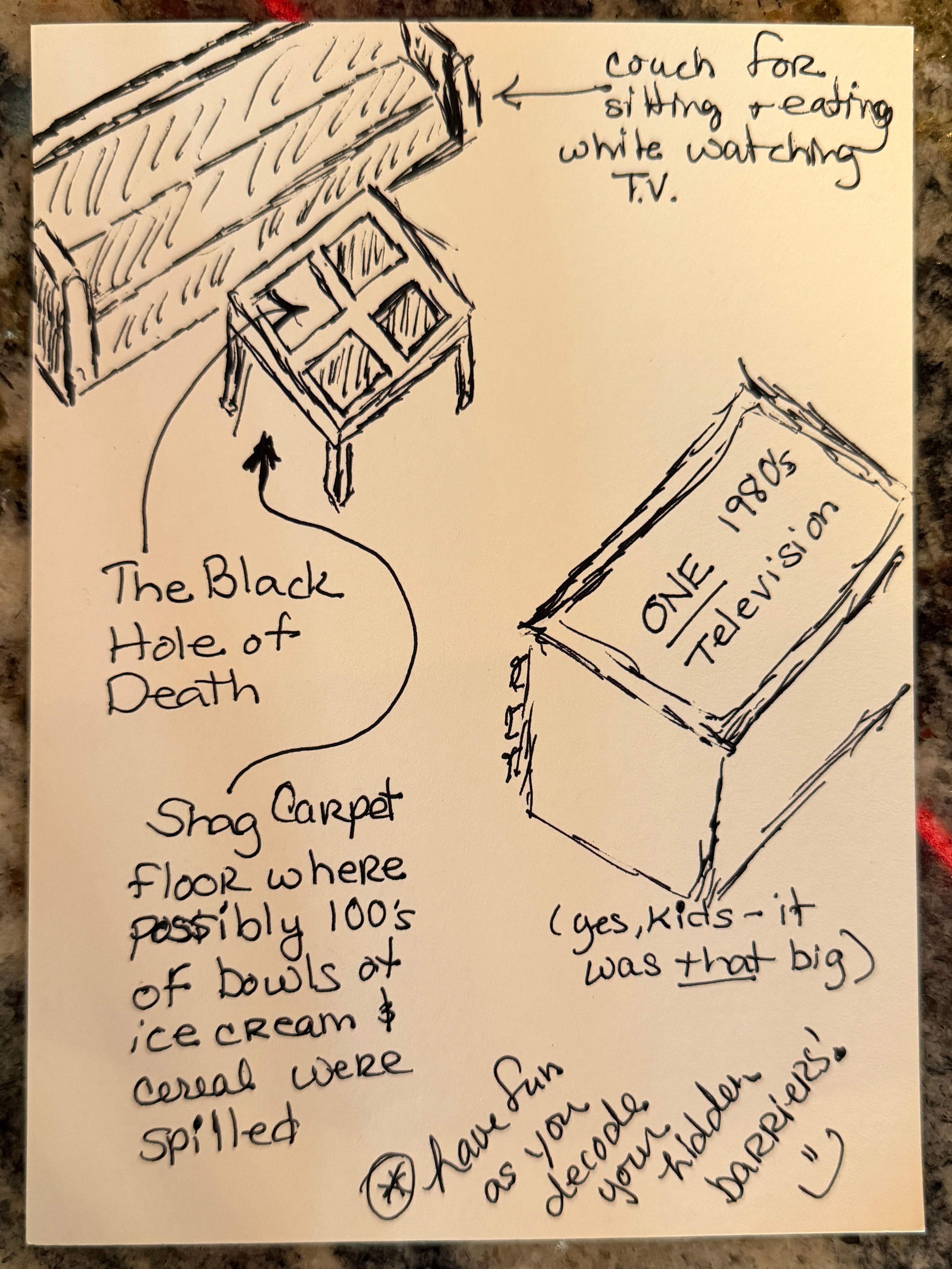
Here’s what we did about that: NOTHING.
My entire family ignored that issue for years.
- Many days when I’d come home after school and sit on the couch to watch tv while I at a bowl of cereal, I’d inadvertently place the milk-filled bowl onto the “nothing” square and it would fall to the ground, spilling layer upon layer of spilled milk onto a shag carpet. Yes I’d clean it up, but I’m certain it was never 100% clean again.
- Others in my family dropped bowls of ice cream, plates of salsa and chips, and all other forms of goodies down that proverbial black hole.
- And as proof that this can be diagnosed as an infectious psychosis that was evidently running rampant through my household, we would even great house guests with a unified chorus of warnings like “Oh, don’t put your glass there… see… that one’s got no glass. You need to use this one over here.”
I never realized how crazy this all must have looked until many years later when the image of those things all ran through my adult head. I was suddenly hit with such an all-consuming laughing attack that I had to eventually lay down on the ground to get my stomach muscles to stop cramping.
Why we have these hidden mental blocks I do not know. But you can see here how they can literally become a black hole. Now with my wise mind turned on, it’s clear there are hundreds of actions anyone in my family could have taken. We could have:
- Hired an expert to create a new glass square to replace the missing one
- Calle the table manufacturer and order a replacement
- Found a piece of cardboard and duct tape it over the open hole
- Cut a piece of plywood and use it to fill in the open square
- Filled the open square with a potted plant
- Hired a large man to continually sit on the hole 24-7
You can see that the possibilities for taking action on the things that trip you up are endless. So please, don’t be like me and my crazy family. Don’t let your hidden barriers fester and get the best of you. They’re gonna make a big mess in your life., and on your shag rug, if you do.
Hugs!