
You're Not Listening — There's No Such Thing As What I Eat in a Day
People keep asking me to do a what-I-eat-in-a-day video. And my response is always: you are not listening. That would be the shortest, dumbest video ever.
There is no what I eat in a day. There is what do I eat in a half hour, once a day. Because I eat OMAD. One meal a day.
But I am going to share it today — because someone requested it — with a very important caveat. I am not sharing this so you can copy it. I am sharing it because the KindEdge philosophy is to show you the why, not the what. And the why is: run experiments. Figure out what works for your body, your genetics, your history, and your life right now. Then keep running experiments, because the right answer will keep evolving.
So here is my story. And it is a long one.
Why I Do Not Spend My Day Thinking About Food
I have optimized the way I eat to fit me. I do not overthink it. I have honed in on exactly what makes my body feel nourished and happy, and then I move on with the rest of my day.
Think about how much time goes into a multi-meal day. Planning the lunch. Making the lunch. Cleaning up from the lunch. Researching the dinner recipe. Going to the store. Prepping. Cooking. Cleaning up again. There is a lot of life in those hours. I use mine to work on things that matter, to build, to play, to create.
I let my stomach be calm and relaxed all day long. Then I sit down, ingest protein after my workout, and let it sink into my muscles. That is it. No meal prep, no recipes, no messes.
But this did not happen accidentally. It took forty years of running experiments through conditions most people never have to deal with all at once. And none of those experiments were wasted.
The Foundation: Celiac Disease, Hashimoto's, and the MTHFR Gene Mutation
Here is what I was dealing with, largely undiagnosed, for the first three decades of my life:
Celiac Disease
In my early teens, my stomach was in a state of constant distress. I was always craving things, always hungry, never full. I exercised every day and watched what I ate, and nothing tracked. I did not know it yet, but I had celiac disease — an autoimmune condition that causes the body to attack the small intestine when gluten is consumed, destroying the villi, the tiny hair-like structures that allow nutrient absorption.
When they finally did the endoscopy, years later, the villi were flat, dead, blunted. I had been beating up my intestines for decades every time I ate wheat — bagels at the office, yogurt-covered pretzels in college, soy sauce at a Chinese buffet on a Sunday morning in my twenties. I had no idea. And the damage had consequences that cascaded through everything: protein absorption, B vitamin processing, amino acid metabolism, gut muscle function. My entire intestines were in a permanent muscle spasm that felt like a rock in my stomach. For years.
Hashimoto's Thyroiditis and Stage Three Thyroid Cancer
I was thirty years old, newly a mother, when the doctor who was doing my son's well-baby checks noticed a small swelling in my neck. He got me into a specialist MRI the same day.
The Hashimoto's had been running undiagnosed for at least a decade, slowly driving my thyroid into cancer. By the time it was found, it was stage three and had metastasized up through the lymph nodes, running up toward my skull. The tumor board at Stanford gave me six months to live at the first findings session. They thought it was a more aggressive type of cancer than it turned out to be.
A few days later, they came back with more detailed lab results. It was a slower-growing type. As long as they were aggressive about removal — and they were, two nine-hour surgeries, a full lateral neck dissection, muscles removed along with the embedded lymph nodes — the prognosis changed dramatically.
I am fifty-four now. My father died at fifty of a heart attack related to newly discovered type two diabetes. So I am on my fourth bonus year. Every year is a gift. Every experiment is an act of honoring him.
The MTHFR Gene Mutation
I eventually discovered I carry the MTHFR gene mutation — specifically the allele that impairs the methylation pathway and makes it very difficult to absorb synthetic B vitamins. The kind you buy at a pharmacy: not bioavailable to people with this mutation. They pass straight through.
The darkly funny part: by the time I got the genetic report and the recommendations — take methylated B vitamins, take NAC, take these specific supplements — I was already taking all of them. Because I had figured it out through experimentation. Decades before the science told me what was wrong, I had driven out twenty minutes to a local nutritionist in college, found natural liquid B vitamin extractions, and noticed they made me feel better in a way nothing else had. My sorority roommates thought I had lost my mind.
I had not lost my mind. I had started running experiments.
The Diet Timeline: Four Decades of Experiments
The Teen Years
Undiagnosed celiac, eating wheat bagels as diet food because fat-free was the 1980s gospel. Exercising every single day. Body fighting me the entire time. Thyroid quietly shutting down. Just feeling terrible and not knowing why.
South Africa and the First Real Education
I finished high school in three years and spent my fourth year in South Africa as an exchange student. There I found a bookshop with homeopathic and nutritional texts — real explanations of what each vitamin does, what each metabolic pathway requires, what happens downstream if something is missing. I read every B vitamin, every mineral, every metabolic mechanism.
I came back from South Africa colorful, shiny, my hair actually shiny. The natural bioavailable supplements I had found there finally gave my damaged celiac system something it could actually absorb. The difference was unmistakable.
University, Early Career, and Still Fighting the Unknown
College at Wake Forest, then working in Chicago, still eating wheat. Bagels at the office because they were fat-free. Stomach bloating on the L train on the way home. Not knowing what the cycle was. Still exercising every day, running along Lake Shore Drive, fighting it. Bathroom habits I now know were not even close to normal and had no idea.
Then California, marriage, a son born at Stanford Hospital. And Dr. Jernick, the pediatrician who also asked, quietly, how are you, who noticed the swelling in my neck and got me into a specialist the same afternoon. Everything changed.
Post-Cancer: The Vegan Years and the Autoimmune Protocol
After the surgeries and several years of treatment, I became deeply focused on reducing inflammation. I went fully vegan. I had enormous salads every day full of kale and vegetables. I still did not feel fabulous. I could not explain why.
Eventually I learned about lectins — the self-defense compounds in many vegetables that can trigger inflammation and autoimmune response in susceptible people. And nightshades: tomatoes, eggplant, certain peppers. All things my vegan diet was built around. So I went on the Autoimmune Protocol diet (AIP) and started systematically removing the most inflammatory foods one by one.
I removed kale. I removed tomatoes. I removed eggplant. I removed gluten-free grains — rice, quinoa. I kept going down the spectrum until one morning I woke up feeling good. And kept feeling good. And my gut, for the first time in my adult memory, was calm.
What was left on the plate at the end of the elimination? Grass-fed beef and salmon. The least inflammatory foods on the spectrum.
I had become carnivore without planning to. I followed the data.
Where I Have Landed: Carnivore OMAD With Microgreens, Almonds, and Zero Apology
I have been running experiments since the carnivore landing, and here is where I am now:
The One Meal
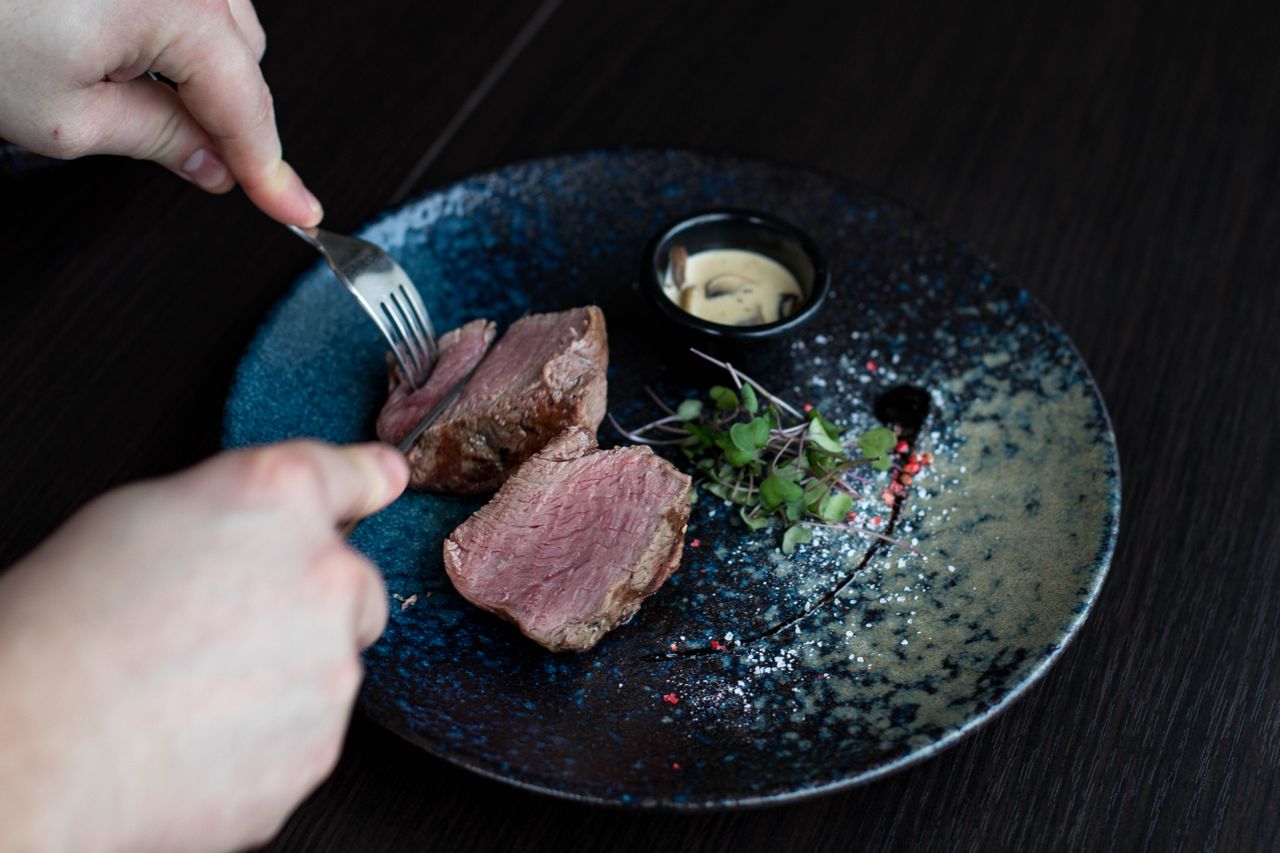
Eaten between 4 and 6 in the afternoon, after a fasted workout. My workout is always fasted — I want my body to do its own cellular cleanup, autophagy, before I give it more fuel. Then I eat:
- A large portion of protein: grass-fed beef, salmon, ground beef, or shrimp depending on the day. Sometimes a 20-ounce cowboy cut ribeye at a restaurant — that is the tomahawk cut with the long bone shortened for the table.
- Bardmore Micro Greens: the properly stressed, tight, crispy kind that contain actual sulforaphane and polyphenols. Not the overwatered, fast-grown grocery store garbage that is already composting in the container. The crunch is the bioavailability signal — when you masticate and bite through properly grown microgreens, the enzymes are released that make the nutrients available to your body.
- Almonds for dessert: pure, dry, nothing added. No palm oil, no roasting oil. Just almonds. Sometimes blended into almond butter. This is my dessert with evening tea.
- Occasionally an Egg Life egg white wrap: found it during the hurricanes when I needed something transportable for hotel rooms. It is the only product in my diet. Everything else is a whole food.
- A glass of wine if it is that kind of evening. Dr. Willard Fee at Stanford, after two years of treatment, signed me off as healthy and I asked him whether I could have wine again. He said: I did not save your life so you could live the rest of it without wine. Amen and correct.
The Morning
Black Americano. Just coffee. Nothing else until the meal. No sweet anything — not honey, not artificial sweeteners, nothing. I discovered that even fake sweeteners trigger an insulin response because the brain perceives sweet taste as a signal that glucose is incoming. If you are low-carb or fasted and you trigger that insulin spike with a sweet flavor and no actual glucose behind it, you crash. Hard. I no longer touch anything sweet and an almond tastes genuinely sweet to me now.
Hydration as a System
Eight water bottles distributed around the house, refilled every night before bed. One in the car always. I prime the pump first thing in the morning — thirty-three to forty ounces before I leave the house. This is not willpower. It is a system. The water is already there. The decision was made the night before. I drink it because it is in my hand and it is the obvious next thing.
On the days I skip the prep, I can feel it by 3 p.m. Terrible and I cannot explain why until I remember I did not prime the pump. The system solved a problem I used to fight every single day.
The Digestion Support
Because I have celiac disease and because my gut has years of prior damage, I take betaine HCL and protease before my one big protein meal. These digestive enzymes ensure the meat breaks down fully into amino acids rather than passing through partially undigested. This is specific to my history and my situation. Your situation will be different.
What I Actually Want You to Take From This
The KindEdge message is never: eat what I eat. My story will not be your story. My celiac disease is not your celiac disease. My MTHFR gene mutation may not be yours. My history of Hashimoto's and thyroid cancer has shaped everything about how I eat in ways that are entirely specific to me.
Life is a journey about discovering what works for you. I went from not feeling good, to finding things that felt better, to discovering celiac and Hashimoto's, to going vegan, to finding that wasn't working, to going down the autoimmune protocol, to landing carnivore. And I keep running experiments. Not because I am restless but because I respect what the data tells me.
The KindEdge approach to nutrition is this: run experiments. Know your why. Do not copy someone else's what. Figure out what makes your body feel nourished, your stomach calm, your energy stable. What makes you wake up feeling good and go to bed feeling good. What makes you not run around hangry. What gives you the foundation to do the hard, long, sustained work of the Project of You.
Big life change is a multi-month, multi-year effort. You will get tripped up and fall down if your body, mind, soul, and systems are not aligned. The foundation has to be a springboard, not something you are fighting every single day.
Figure out what feeds you. Then make it default mode.
Join a community of people who aren't waiting for the dream they crave. We're taking stupid-easy daily actions that get things moving in real life: kindedge.com/subscribe
And if you're multi-tasking but want to carry on, just pop over to the latest video about your journey—The Project of You—to unlock the alternate ending to your life: youtube.com/@kindedge