



Expectations are usually seen as a good thing. They are generally marinated in positive anticipation of something known, planned or intended yet to come. A mother who is expecting eagerly anticipates the birth of her little one. An employee might be expecting a promotion soon. A lonely person might be expecting an invited guest to visit the house later today.
Expectations Part 1: Set high expectations and attack them with optimism
You can use your attachment to expectations as a tool to amplify your resolve to achieve a tough goal. If, from the very start, if you define high expectations for yourself, clearly envisioning yourself achieving some feat that far exceeds any of your past achievements, you will become attached to the positive emotion that image evokes. As a result, you’ll be more energized to do the hard work required to achieve it.
Training for a marathon sounds like drudgery until you clearly envision your 1st place photo-finish. With this goal in mind, you’ll be more likely to be the only member of your training team to show up every single training day, rain or shine.
When you set up the expectation of winning, you begin to taste it. Every time you put on your running shoes, you begin to savor the sweetness of the future win you’re working toward. And when you get used to that, then the idea of you not winning seems repulsive. At any point during your training wherein you don’t seem to be hitting key milestones, you’re more likely to run faster to avoid future disappointment. You want that win. You are attached to the hard work that will connect you with the joy of winning.
So in this version of using expectations as a lever, you can see that it’s a great tool to propel your forward to achieve your biggest goals. Kind of like dangling a carrot in front of your own face. Pretty cool.
Expectations Part 2: Using Expectations to Strategically Wrangle Trouble
Another way you can make use of humans’ attachments to expectations is to use it as more of a defensive tool.
We expect other people to show up on time like we would, or follow through on a promise like we would, or give us the promotion that was promised. But that is the wrong way to invest our emotional “expectation” energy.
Chasing an expectation wherein the outcome is controlled by someone else can lead us not only to disappointment, but to truly have our long-term needs and goals placed at risk. If we are expecting something from some other person or entity, what levers of control do we have over the outcome?
If we have an expectation regarding an employer’s promise or a loved-one’s commitment, our emotional attachment to that expectation is going to drive us to run like a hamster on a hamster wheel until the result is achieved. But do we know the other party will actually follow through on that deal?
When we have no certainty that another party will follow through on a future act, we can only look to past patterns to understand rationally, and truthfully, what we can likely expect.
Too often when we get emotionally attached to a future possibility, we suffer a sort of amnesia about the truth of the past. Despite the tech co’s ads hyping up the life-changing nature of their latest product launch, does history really show that any product is really going to fundamentally transform your life? And despite her professed excitement about going out tonight, is the friend who always shows up late really going to show up in time for the show you bought tickets to?
The best way to use your attachment to expectations is to be prepared for the future by looking at the past and expect it.
There is such a moral taboo placed on labeling people. But we need to label people to avoid giving chaos-makers a free pass to hijack our lives. How quickly you forget the past when you get an emotional, urgent text from an old buddy, Charlie, who says he needs to talk to you right now. You pick up the phone and your friend then pressures you into rescuing him from an emergency he created for himself through poor planning and neglect of responsibilities.
You know what you forgot to do? You forgot to expect it. Wanna know a life hack that will save you from yourself in these situations? Edit Charlie’s name in your phone to read Wait-60min-to-reply-let-Charlie-handle-his-own-problems. You will feel evil for labeling a friend like this but the next four or five times you save your own day by not getting hooked into his false emergencies, you’ll love this little hack.

We need to get into the habit of consciously evaluating and labeling all the people, environments and things in our lives for exactly what they are based on past behaviors. This “anti-rose-colored-glasses” mode is a life skill that enables us to navigate chaotic situations without necessarily being drawn into the chaos.
Here are a few more examples. It is a rational and relatively safe bet that the employer, or friend, or organization that, for the last five years, has always been on time, truthful or dependable will be there for you and follow through again.
However, if you find yourself twisted in a knot nervously waiting for your unreliable brother to pick you up and get you to the airport on time, you might be living in future expectations that don’t match the past patterns. You use expectations as a lever of control by reversing your expectations. Instead of nervously worrying he’s going to be late, just expect it and rather schedule a ride with a dependable driver service.
If your lying, cheating, gambling manipulative spouse continues to lie and cheat and gamble and manipulate throughout your divorce, stop wasting your energy on ineffective behaviors like dropping your jaw and clutching your pearls with every new transgression. Expect it!
And if your employer continues to dangle the promotion carrot with all its high performers yet continues to point to market fluctuations when it repeatedly delays or denies promotions, stop wishing, wanting and waiting. Expect it!
You can see here that the minute you master the skill of expecting it, you transform your awareness of others’ patterns into a strategic tool for owning and planning a better path forward. When you plan for known patterns you will get to the airport on time and still find a way to love your fun-albeit-inconsistent brother. When you proactively educate your divorce attorney on all the money-shifting and related games your spouse tends to play, you and your attorney are better able to plan for his chaos. And when you make sure to have multiple outside job offers in hand when you communicate to your current employer that you want that promotion, you are more likely to see them take action, and if not, then you hold the cards and can make your next move.
Old Habits Die Hard: You Need Totems to Get This “Expect It” Hack Working
When I was building KindEdge for myself, I ran hundreds of tests to define the short list of action-oriented tools and hands-on hacks that actually work in real life.
Where all the other guru inspo and advice-for-the-fictionally-perfect-day fails, my KindEdge tools are the doable steps that create immediate movement whenever you are stuck.
One of the hacks I developed is to embed the new mindsets and behaviors you are working on into objects that you will have with you throughout the day. I call these objects totems; they bring the words of your wise mind out of the ineffective “theoretical” background and into the exact real life place and time where the real sh*t happens.
My many tests proved that no matter how well we comprehend the concepts being espoused in expert books, those learnings will not get embedded into our default wiring until we have a chance to invoke them repeatedly in real life situations.
Your old default wiring is deeply embedded within you. When an unexpected event occurs during the day, your brain is not going to take the time to think about the guru inspo book that is collecting dust on your bedstand. Your default mode will size up the situation and immediately call upon your historically most-used default reaction to that type of situation.
So how do you grab the reins in these moments to redirect your brain toward trying out a new skill? Well, you need to have the words of your wise mind staring you in the face, speaking more loudly than your old defaults.
For example, if you have this “Expect It” mug from the KindEdge Amazon shop:
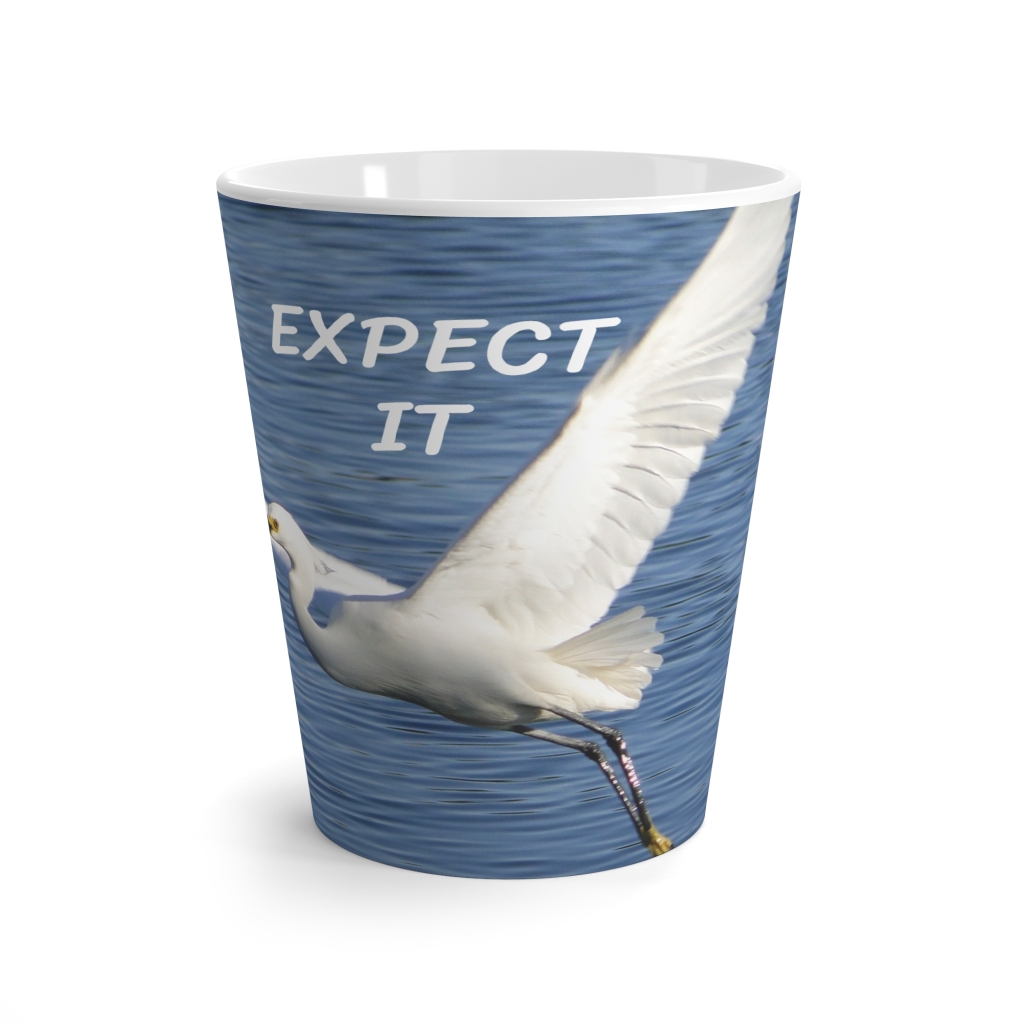
Sitting on your desk, then the next time your attorney calls to notify you that your soon-to-be-ex has done another crazy thing, you will have that mug there to quickly reconnect you with your wise mind.
Instead of ineffectively flailing about like a turtle on your back as per your old default reactions, you will instead be reminded to use what you know about your ex’s behavior patterns to strategically guide your attorney on the most effective next steps.
This “expect it” mode is a superpower and it will save you hundreds of thousands of dollars and hours that would otherwise be lost to wrestling with pigs.
And while the first few times you use a new behavior it may feel awkward and effortful, over time, the more you use this new skill, the more it becomes your new default groove.
Through many tests and trials, you will see evidence of new behaviors and mindsets that work far better than your old ways. From there you’ll see an even bigger transformation in yourself. You will no longer feel like a victim who is forced to drop everything and react every time someone in your life does something manipulative or wrong.
Instead, you will enjoy a less-reactive state of observation. When a bad event occurs, you won’t be triggered to react. Your default will be to think to yourself “Ah! I recognize the game this chaos-monkey’s playing oh too well! Lucky for me I’ve got a playbook for it.”
So this “expect it” version of harnessing your attachment to expectations helps you stay on your own path more often, even though chaos is bound to exist.
Expectations Part 3: Stop Trying to Numb the Pain of an Expectation Hangover by Pretending that Some Guru Out There Can Deliver the Certainty You Crave
A third way of leveraging your attachment to expectations is to unleash the pain of disappointment as a positive force to ignite big changes in your life. Too often we work too hard to make things work as they are. What if things just don’t work as they are? What if this disappointment about something we’d expected is a painful but wonderful sign that we need to make a big change?
Tell Me the Way
When you Google, or Chat GPT or browse a long list of expert books and advice, you are screaming out “Just tell me the way! Give me the certain path forward!”
Guess what? Plenty of people out there are happy to be there in the search results of whatever you Google. They’ll gladly take your time and money and in exchange sell you on some promise that they have the certainty you seek.
The emotions you feel when your expectations are not being met, despite you having done all the right things, should not be placated by some false promise of certainty. You should look within yourself and say “this emotional energy should be used to fire up big change within me!” Instead of reading some expert book in hopes of self-soothing (yet remaining stuck in a toxic situation) we should use the energy of our discomfort to move, to change, to be disruptive in order to transform our lives.
I personally earned myself a PhD in psychology and I memorized 80% of the DSM-5 manual that is intended not for lay people like me, but rather as a diagnostic reference for professional psychologists. For decades I felt it was my duty to work harder to gain a deeper understanding of the roots of intentionally chaotic and hurtful behavior around me. I looked to experts to give me the “correct” and “advisable” path for handling something that was simply a black-and-white case of someone being a complete a-hole for decades.
But for every new question I asked to try to find solutions, a new guru or guide would appear and I’d invest more time and money in hopes that that new information would prescribe the correct path forward. I worked harder and harder to find an effective solution that just never appeared. I had little respect for my own gut, as I assumed outside experts would know best.

However, I eventually discovered another KindEdge lifehack that makes the truth of a complicated situation just stupid-easy to see: This KindEdge hack is called “Black Box It.”
Instead of continuing to dive deeper into diagnoses and theories that might explain-away chronically toxic behaviors, I learned to put all the little details into a mental Black Box.
When all the big medical words and explanations and opinions were packed tightly into that black box, I was then able to back up and ask the simplest question about everything in there:
I did not need one more explanation or theory or trial attempt or methodology. I needed to make a CHANGE. A big one. One I had been avoiding. One that would push me past my edge.
Every time I’ve pushed past my uncomfortable edge in my life, I’ve unlocked something better.
The black-box-it hack and the KindEdge mantra of “Do What Works IRL” are tools for getting you unstuck. When wishing and hoping leave you waking up every day with an expectation hangover, what you really need is change.
Get Out of the Caldron of Boiling Hot Water!
Want to know something ironic? One of the books that gave me an expectation hangover was a book called Expectation Hangover. I have nothing against the author, but I know that when someone gets far enough down the path of sustaining repeated injuries by a disordered chaos-maker, they need far better advice than to read to the end of the latest palliative book. In many cases, when you reach the end of some expert’s book, you’re still living in a caldron of scalding hot water, but you’ve simply gained a better understanding of what heat is.
In the case of the Expectation Hangover book, it should not have been a 70,000 word tome. In 55 simple words it could have said:
If you bought this book, then don’t read it; just go ahead and make whatever huge changes you need to make to ensure your life begins to be respected, and feel good, immediately. Do not search for any other explanations for why someone else is not respecting your life. Just close this book and run.
Now that’s the kind of self-help book we all should be reading.
Your Next Steps
If you feel like you've been doing all the right things, and following all the expert advice, only to end up seeing that the “black box” data shows that the situation’s still broken or that it leans far too hard on you to keep it afloat, you might need to stop listening to experts who sell you certainly and rather take action on your gut.
This applies to your career, your lifestyle, your daily schedules, your relationships, and more.
Look at your life and figure out what’s not getting the oxygen it needs. Your passions and your goals are serious matters requiring serious investment. We should expect that we will be able to use our one golden ticket here on Earth to leave a mark before it all ends. If un-fit people or organization or situations are holding you back from expressing what you were placed here on Earth to do or create, then you urgently need some big life change.
Take a look at the KindEdge Steps at https://kindedge-news.com/phase-one. They get you in motion with a real “do it with you” project plan to ensure that from here on out, your life minutes can be used in a meaningful way that will leave your mark.
You can also take a look at this video that goes deeper into situations in our life that would benefit from a baseball mindset: 1, 2, 3 strikes - you’re out.