



Cleaning Out Bad People Is Only Half the Work
When you decide to make a big life change — a new career, a health goal, a major personal pivot — one of the first things KindEdge 360 asks you to do is consciously curate the people around you. This means actively choosing who stays, who goes, and who gets invited in going forward.
Most people get this part partially right. They identify the chaos makers. They start pulling back from friendships that drain them. They recognize the employer who's been using them or the relationship that's been running on fumes. And they make moves.
But here's what almost nobody does: they don't stop to diagnose how they got there in the first place.
That diagnosis is the real superpower. Because if you skip it, you will clean up your current circle perfectly and then walk straight into an identical situation with a completely new cast of characters.
The Pattern Is More Useful Than the People
It's not really about the specific bad employer or the specific difficult ex. It's about the pattern that connected you to them.
When you look back honestly at the non-keepers in your life, the people who turned out not to be right fits or who were genuinely harmful, there are usually concrete, specific circumstances and behaviors that were present at the start. Not vague red flags. Actual concrete details.
And when you look at the keepers, the magical employers, the genuinely wonderful clients, the friends who show up on your worst day not just your best day, there are equally concrete factors there too. Things you did. Questions you asked. Tests that got run, maybe without you even realizing you ran them.
It is a superpower to really diagnose and look into how you chose, or got adopted by, the various people in your life. Because you can get rid of a bad employer, but you will dance right into another tango with an identical situation if you don't figure out the concrete specifics of how it happened.
That side-by-side analysis, keeper versus non-keeper, is one of the most valuable exercises in the KindEdge process. Not to assign blame or rehash old wounds. To extract tools you can use going forward for the rest of your life.
The Adoption Trap: How You End Up in Someone Else's Story
One of the most common patterns I see, and one I have lived myself, is what I call getting adopted.
It happens like this: you are going about your life, maybe a little passive, a little accommodating, maybe in a season where you don't have a strong, clear sense of your own direction. And then someone else's world comes toward you. They seek you out. They pull you in. Out of niceness, politeness, and maybe some social inertia, you let it happen.
Suddenly you are swept into their style of living, their drama, their social world, their priorities. And at some point you surface and think: wait, why isn't this working for me? Why does everything seem to revolve around their needs?
The answer is that you were adopted into their story. You didn't actively choose them. They chose you, for reasons that had more to do with their needs than with genuine mutual fit.
This happens in romantic relationships, in friendships, in professional settings, and with employers. It is not your fault. But it is your responsibility to learn to recognize the pattern early and interrupt it.
Trophy Picking and Vulnerability Windows
Two specific non-keeper patterns are worth naming directly because they're so common and so hard to spot in the moment.
The Trophy Picker
This is someone who finds you when you are at your most visible and vibrant — going viral, having a great season, at the top of your game. They are drawn to that version of you as a prize. They want you on your best day.
The problem is that best-day relationships never get tested until something hard comes along. And when it does, you discover that the interest was in the trophy, not in you. The person who could not see you on a bad day was never really seeing you at all.
The Vulnerability Window
This is the inverse. Someone finds you in a low moment — a difficult family situation, a loss, a period of exhaustion and self-neglect. You are not yourself. And a certain type of person who needs to feel superioris drawn to exactly that version of you.
Then life moves forward. You get back to yourself. You bloom back into confidence and momentum. And that person pulls back, becomes cold, or actively undermines you. Because the version of you they were drawn to no longer exists. You outgrew the dynamic they were counting on.
When you understand this pattern, past relationships that confused you often start to make a lot more sense.
The 50-Yard-Line Test: The Most Useful Filter I Know
Here's the practical tool I use constantly and teach in KindEdge: the 50-yard-line test.
In any relationship, professional or personal, a fair deal means both people meet in the middle. Not one person always going 100% to the other person's side of the field while the other stays put. The middle. The 50-yard line.
The test is simple: stop going all the way to their side. Make a clear, reasonable, fair ask. Ask them to come to your side of the field for once. And then watch what happens.
If they show up, you have data. That person is capable of reciprocity. That is a keeper signal.
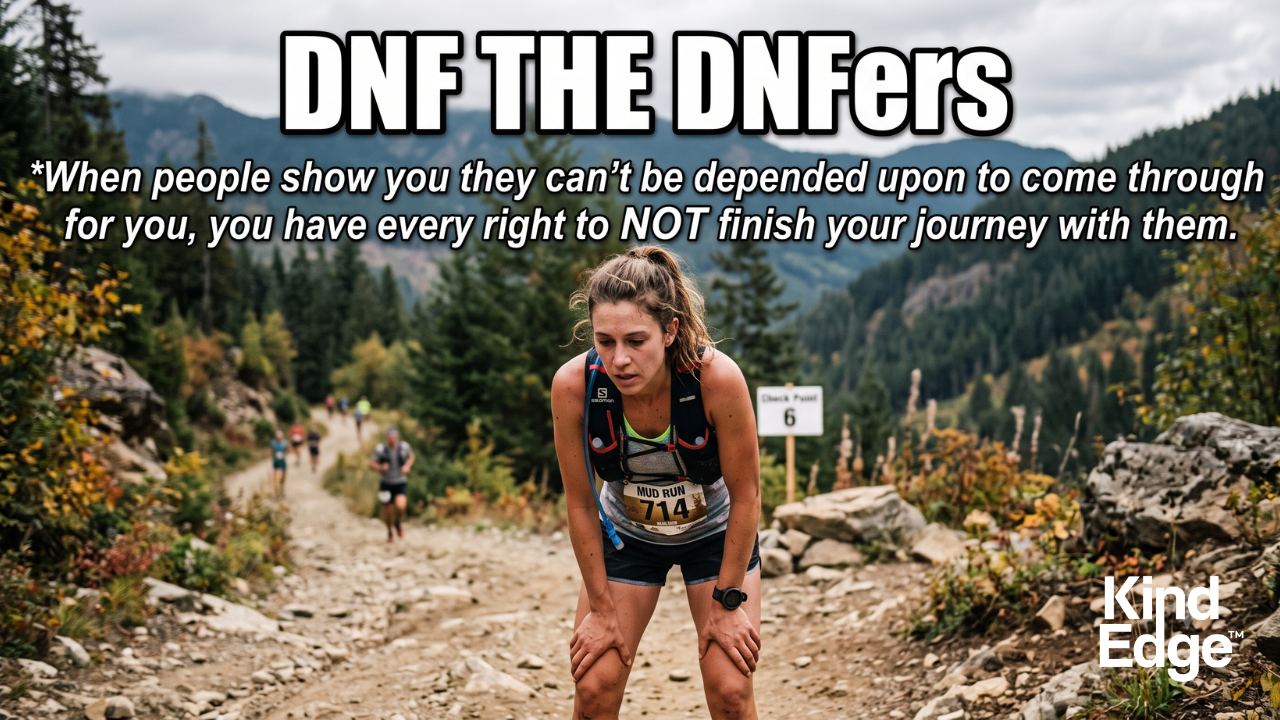
If they resist, deflect, punish you for asking, or simply don't come, you have different data. That is a non-keeper signal. And more importantly, it is data you could not have gotten any other way, because you were always going all the way to their end. You never created the conditions where their true behavior could surface.
This applies to employers who keep understaffing and overpromising and expecting you to work weekends and holidays to cover the gap. When you finally hold a fair boundary, the response tells you everything. It applies to friends, clients, agencies, collaborators. Everyone.
Interview and Test: The Active Art of People Selection
Getting a keeper is not an accident. It is an active act. It requires you to treat new people the way a good recruiter treats candidates: with real questions, real tests, and real evidence before trust is extended.
Ask Actual Questions
Not just the surface-level ones. Ask about how they handled a difficult situation with a previous client, employee, or partner. Ask what they would do if a project went sideways. Ask what they consider a fair working relationship. Their answers are data. Their comfort or discomfort with those questions is also data.
Get Real References
Not the testimonials on the website. Not the pitch call. Real human beings who have actually worked with this person or organization in your specific context, in private, without a sales agenda. This is old-fashioned but it remains one of the most reliable filters that exists. If someone cannot produce references who speak well of them after the relationship, that is information you need.
Test in Real Life
All the good interviews in the world mean nothing until you see the behavior in actual real-life conditions. Small tests first. Make a reasonable request. Introduce a mild inconvenience. See how they respond when things are slightly imperfect. The way someone handles a small test is the best predictor of how they will handle a real one.
Everybody gives you their best pitch if they want something from you. The only real filter is finding people who still speak well of someone after the sales call is over and the rubber has met the road.
Conscious Curation Is a Skill You Grow for Life
Here is the reframe I want to leave you with. This is not about being cold or transactional with people. It is about being clear. About understanding your own patterns well enough to stop repeating them. About knowing what a genuine match looks like so you can recognize it when it appears.
You are going to meet people for the rest of your life. You are going to have employers, clients, collaborators, friends, partners. Everyone of those relationships is an opportunity to either repeat an old pattern or demonstrate a new skill.
The keepers in your life, the ones who show up on your worst day, who meet you at the 50-yard line, who speak well of you when there's nothing in it for them, are not accidents. They came into your life because of something you did, some question you asked, some test you ran, some standard you held.
Learn what that was. Repeat it. And keep raising the bar.
Join a community of people who are done waiting on the dream in the back of their head and actually doing something about it: kindedge.com/subscribe.
Or just pop over to watch the latest video: youtube.com/@kindedge